
By Fadi Minawi, U.S. Immigration Attorney
Co-founder, ImmiPrep.ai | Published September 17, 2026
Reviewed for accuracy against official U.S. Department of State sources. Last updated September 17, 2026.
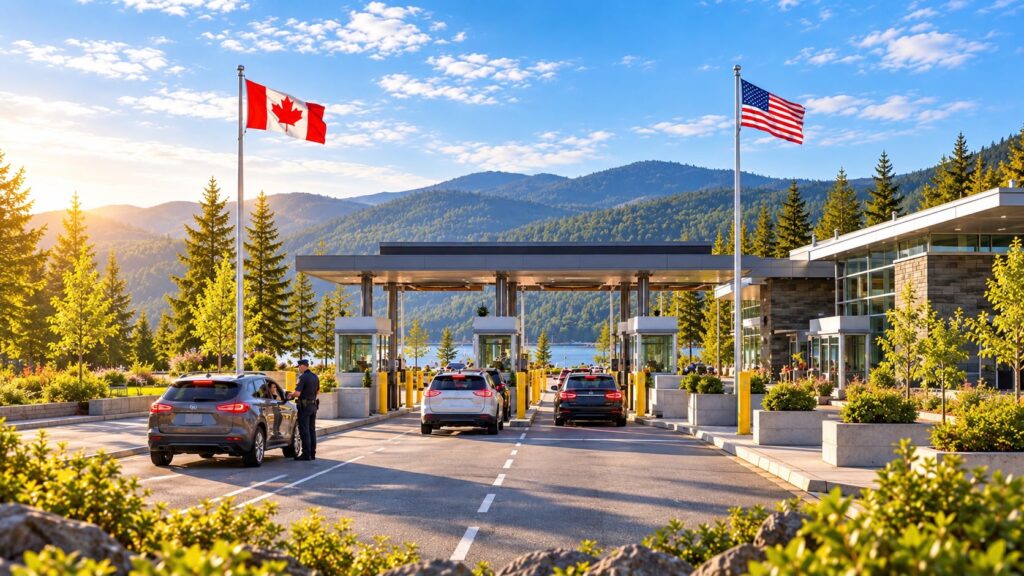
Living in Canada does not, by itself, determine whether you need a visa to visit the United States. Canadian citizenship generally allows visa-free travel for short tourism or business visits, while Canadian permanent residence, a work permit, or a study permit does not create the same exemption. At the same time, some non-Canadian citizens living in Canada may qualify to travel under the Visa Waiver Program (VWP) with an approved ESTA, depending on their nationality and individual circumstances.
If you do need a visa for tourism, family visits, or temporary business travel, the usual category is a B-1/B-2 visitor visa. This guide explains the current process for a non-Canadian citizen who is lawfully residing in Canada and applying from Canada.
Key Takeaways
- Canadian residence alone does not determine whether a visitor visa is required. Nationality, Canadian citizenship, and possible Visa Waiver Program eligibility all matter.
- Applicants who need a B-1/B-2 visa must complete Form DS-160 and generally pay a $185 USD non-refundable application fee before scheduling the interview.
- As of October 1, 2025, most nonimmigrant visa applicants generally require an in-person interview, including applicants under 14 and over 79, subject to limited exceptions for certain renewals and other categories.
- A person applying in Canada based on Canadian residence should be prepared to demonstrate that residence and the ties that support a temporary trip. Those ties may be to Canada, the country of citizenship, or both, depending on the person’s circumstances.
- FY2025 B-visa refusal rates are published by nationality, but they are population-level statistics and should not be treated as an individual applicant’s odds of approval.
- Applicants should also check whether any current nationality-based visa issuance restrictions apply before investing time or money in the process.
At a Glance
| Step | What to Do |
| 1. Confirm whether you need a visa | Check whether you can travel visa-free as a Canadian citizen or under the Visa Waiver Program, or whether a B-1/B-2 visa is required. |
| 2. Check where and whether you can apply | Confirm that Canada is an appropriate place of application based on your residence and check for any nationality-specific visa restrictions. |
| 3. Complete Form DS-160 | Submit the online nonimmigrant visa application and save the barcode confirmation page. |
| 4. Pay and schedule | Pay the $185 USD fee and schedule through the official visa appointment system for Canada, not through CEAC. |
| 5. Prepare your case | Be ready to explain your trip, finances, immigration status in Canada, and the ties that support your intention to leave the United States after the visit. |
| 6. Attend the interview | Answer clearly, directly, and consistently. Bring the required documents and any useful supporting evidence. |
By the Numbers
The State Department publishes adjusted B-visa refusal rates by nationality. The examples below pair FY2025 refusal-rate data with several nationalities that are well represented among immigrants, recent immigrants, or non-permanent residents in Canada:
| Nationality | FY2025 Adjusted B-Visa Refusal Rate | Why Relevant to Canadian Residents |
| India | 22.04% | Canada’s largest recent-immigrant source country in the 2021 Census and the leading place of birth among non-permanent residents. |
| Philippines | 30.76% | One of Canada’s largest recent-immigrant source countries and a substantial immigrant community in Canada. |
| China | 20.21% | One of Canada’s largest immigrant source countries and a leading place of birth among non-permanent residents. |
| Nigeria | 57.00% | A notable source of recent immigrants; in the 2021 Census, Nigeria was also the leading place of birth among non-permanent residents who were asylum claimants. |
| Pakistan | 52.32% | A significant source country for recent immigrants and a substantial immigrant community in Canada. |
Important context: these are worldwide refusal rates by nationality, not approval probabilities for a particular person applying in Canada. They do not account for the individual facts of a case, the applicant’s Canadian residence, or later changes in visa policy. The Canadian-resident context in the chart is drawn from Statistics Canada’s 2021 Census data and is included to explain why these nationalities are relevant to this article. For example, as of January 1, 2026, visa issuance and entry are fully or partially suspended for nationals of certain countries under Presidential Proclamation 10998, subject to stated exceptions. Nigeria is among the countries subject to a partial suspension affecting B-1/B-2 visa issuance.
Step 1: Confirm Whether You Actually Need a Visa
Start with nationality and the purpose of travel, not simply Canadian residence.
- Canadian citizens generally do not need a nonimmigrant visa for ordinary short tourism or temporary business travel to the United States, although some visa categories and circumstances are exceptions.
- A Canadian PR card, work permit, or study permit does not itself create visa-free U.S. travel rights.
- A resident of Canada who is a citizen or national of a Visa Waiver Program country may be eligible to travel for qualifying tourism or business for up to 90 days with an approved ESTA instead of obtaining a B visa.
- If neither the Canadian-citizen exemption nor the Visa Waiver Program applies, a B-1/B-2 visa will generally be required for short business or tourism travel.
Official guidance: Tourism & Visit | Visa Waiver Program | Citizens of Canada and Bermuda
Step 2: Check Where You Should Apply and Whether Any Nationality Restrictions Apply
As of July 15, 2026, the Department of State instructs nonimmigrant visa applicants to schedule their interview in their country of nationality or residence. A person applying in Canada based on residence should be able to demonstrate that Canadian residence.
Department of State guidance on applying in the country of nationality or residence
Before applying, also check whether your nationality is subject to a current suspension or restriction on visa issuance or entry. These rules can change and may include exceptions based on factors such as dual nationality, existing visas, or specific categories of travel.
Current State Department guidance on visa issuance suspensions
Step 3: Complete Form DS-160
Every B-1/B-2 applicant must complete the DS-160, Online Nonimmigrant Visa Application, electronically. After submission, save and print the confirmation page containing the application ID and barcode. You do not need to print the entire application for the interview.
DS-160: Online Nonimmigrant Visa Application
Practical point: Review the DS-160 carefully before submitting it. Your interview answers should be consistent with the information in the application. If an important fact has changed or an error was made, address it truthfully rather than trying to force your interview answers to match an incorrect form.
Step 4: Pay the Application Fee and Schedule the Interview
The B-1/B-2 nonimmigrant visa application processing fee is currently $185 USD and is non-refundable regardless of the outcome.
Department of State fee schedule
The DS-160 itself is completed through the Consular Electronic Application Center (CEAC), but interview scheduling is handled separately. Applicants in Canada should follow the official Canada visa appointment instructions and scheduling system.
U.S. Visa Information and Appointment Services for Canada
Appointment availability varies significantly by post and changes over time. Check current wait times before making non-refundable travel plans.
September 2026 update: Mission Canada is participating in the Department of State’s temporary Nonimmigrant Visa Expedited Appointment Pilot Program. Eligible B-visa applicants who first schedule a regular appointment may, subject to availability, pay an additional $750 fee for an appointment within 10 business days. The pilot is scheduled to run through December 31, 2026, and an expedited appointment does not guarantee visa issuance.
Nonimmigrant Visa Expedited Appointment Pilot Program
If your travel dates are firm, this is the point to start preparing for the interview itself, not after an appointment is booked. Try a free ImmiPrep.ai mock interview to see what the actual interview format feels like before your appointment is scheduled.
Step 5: Prepare to Demonstrate a Temporary Purpose and Meaningful Ties
A common ground of refusal for B-1/B-2 applicants is INA Section 214(b). A 214(b) refusal can mean that the applicant did not sufficiently establish eligibility for the requested visa and/or did not overcome the presumption of immigrant intent by demonstrating ties that would compel departure after the temporary U.S. visit.
U.S. Department of State: Visa Denials and INA Section 214(b)
For someone who actually lives in Canada, Canadian ties can be highly relevant. Employment or studies in Canada, lawful immigration status, a home or lease, family relationships, financial commitments, and an established life in Canada may all help explain why the trip is temporary. Ties to the applicant’s country of citizenship may also matter, but there is no rule that a Canadian resident must prove ties only to the country whose passport they hold.
- Be ready to explain why you are going to the United States and how long you intend to stay.
- Be able to explain who is paying for the trip and whether the proposed travel is realistic in light of your income and circumstances.
- Be prepared to explain your current status and life in Canada, including employment, studies, family, housing, or other commitments that are genuinely relevant.
- If you also maintain meaningful ties to your country of citizenship, those may be relevant as part of the overall picture.
- Invitation letters or supporting documents can help explain the trip, but the officer evaluates the applicant’s own eligibility and circumstances.
Step 6: Attend the Interview
As of October 1, 2025, the Department of State generally requires in-person interviews for nonimmigrant visa applicants, including applicants under age 14 and over age 79. Limited exceptions remain, including certain B-1/B-2 renewals within 12 months of the prior visa’s expiration when additional eligibility requirements are met. Even when a waiver category applies, a consular officer may require an interview.
Interview Waiver Update, September 18, 2025
- Bring the DS-160 confirmation page, a valid passport, and the documents required by the post.
- Bring supporting evidence that is genuinely relevant to your trip and circumstances, but do not assume that a large document package substitutes for clear answers.
- Answer the question asked. Clear, direct, truthful answers are generally more effective than rehearsed speeches.
- If you do not know an answer or need to correct something, say so rather than guessing.
Why preparation matters: B-visa interviews are often brief. Practicing can help applicants organize their facts, identify inconsistencies before the interview, and become more comfortable explaining the trip and their ties without sounding scripted.
Practice with a free ImmiPrep.ai mock interview to rehearse your answers about your trip, funding, and ties before the real thing.
How ImmiPrep.ai Can Help
ImmiPrep.ai is an AI-powered mock interview platform designed to help B-1/B-2 visa applicants practice realistic consular interview questions and receive personalized feedback. The goal is not to supply scripted answers. It is to help applicants become more comfortable explaining their own facts clearly, accurately, and consistently.
Applicants can use a mock interview to practice questions about the purpose of travel, funding, Canadian residence, employment or studies, family circumstances, prior travel, and return plans before the actual interview.
Start a free ImmiPrep.ai demo to practice answering questions about your trip purpose, ties to your home country, and travel plans before your actual interview.
Professional Insight
Fadi Minawi, U.S. Immigration Attorney and Co-Founder of ImmiPrep.ai, offers this perspective:
“A Canadian resident should not assume that the officer will ignore the life they have built in Canada simply because they hold another country’s passport. If Canada is genuinely where the applicant lives, works, studies, or has family and financial commitments, those facts may be central to the 214(b) analysis. The interview still has to make sense as a whole: why you are travelling, how the trip is being funded, and why the visit is temporary. Practicing those answers out loud can help an applicant identify gaps or inconsistencies before presenting themselves across from a consular officer.”
About the Author
Fadi Minawi is a U.S. immigration attorney and co-founder of ImmiPrep.ai, where he works with immigration and technology professionals, including former government immigration officers, to develop mock visa interview tools for B-1/B-2 applicants. Fadi tracks nonimmigrant visa policy developments and translates State Department updates into practical guidance for visa applicants.
Editorial Policy
This article is provided for general informational purposes only and does not constitute legal advice. Visa eligibility depends on each applicant’s individual circumstances, and U.S. visa rules, appointment procedures, travel restrictions, fees, and interview-waiver policies can change. ImmiPrep.ai is not a law firm and does not provide legal representation. Applicants with complex cases should consult a licensed U.S. immigration attorney.
Sources
- U.S. Department of State, Tourism & Visit
- U.S. Department of State, Visa Waiver Program
- U.S. Department of State, Citizens of Canada and Bermuda
- U.S. Department of State, Visa Denials
- U.S. Department of State, DS-160: Online Nonimmigrant Visa Application
- U.S. Department of State, Fees for Visa Services
- U.S. Department of State, Global Visa Wait Times
- U.S. Department of State, FY2025 Adjusted Refusal Rates by Nationality (B Visas)
- U.S. Department of State, Interview Waiver Update, September 18, 2025
- U.S. Department of State, Adjudicating NIV Applicants in Their Country of Residence, July 15, 2026
- U.S. Department of State, Suspension of Visa Issuance to Foreign Nationals, Presidential Proclamation 10998 Guidance
- U.S. Department of State, Nonimmigrant Visa Expedited Appointment Pilot Program
- U.S. Visa Information and Appointment Services, Canada
- Statistics Canada, 2021 Census Profile – Canada
- Statistics Canada, Non-permanent Residents in Canada: Portrait of a Growing Population from the 2021 Census


 English
 Spanish
 Portuguese
 French
 Tagalog
 Arabic