
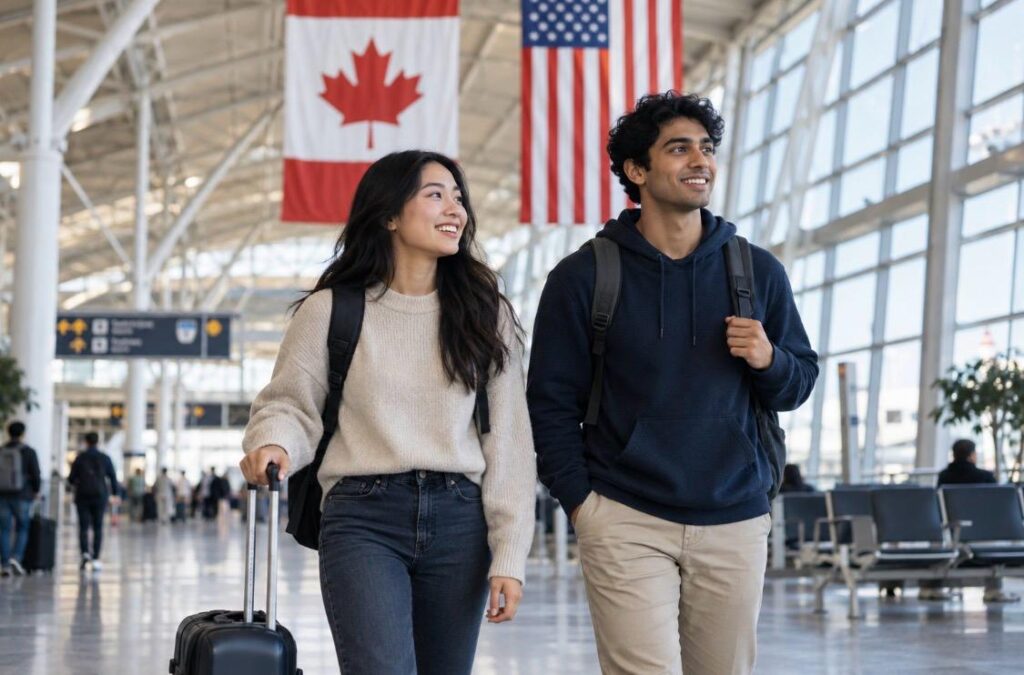
By Fadi Minawi, U.S. Immigration Attorney
Co-founder, ImmiPrep.ai | Published September 18, 2026 | Last reviewed September 21, 2026
Short answer: yes, often. If you’re an international student in Canada and your family is in the United States, visiting relatives is a permitted B-2 visitor visa purpose. Your Canadian student status does not automatically qualify you for a visa, but it can be relevant because your studies, lawful residence, and day-to-day life in Canada may help show why your trip is temporary. Your nationality, whether you qualify for visa-free travel, where you apply, your finances, and your ties outside the United States all matter.
Key Takeaways
- Visiting relatives qualifies as B-2 travel, but a visitor visa does not permit regular study, employment, or permanent residence in the United States.
- Canadian citizens generally do not need a visitor visa for short tourism or business trips. Eligible nationals of Visa Waiver Program countries may instead travel with ESTA; most other international students in Canada will need a B visa.
- The State Department currently directs nonimmigrant visa applicants to schedule in their country of nationality or residence. If you apply in Canada based on residence, be prepared to show that you genuinely reside here.
- Before paying fees, check whether your nationality is affected by Presidential Proclamation 10998 or the Visa Bond Program. Either can materially affect a B-visa application.
- A U.S. relative’s invitation letter is not required and is not one of the factors the State Department says it uses to decide visitor-visa eligibility. The focus is on your own circumstances and temporary travel plans.
At a Glance
| Step | What to do |
| 1. Pick your path | Check whether your passport qualifies for ESTA travel under the Visa Waiver Program. If not, you will generally need a B-2 or B-1/B-2 visitor visa for a family visit. |
| 2. Check restrictions | Review Presidential Proclamation 10998 and the current visa-bond country list before paying fees. |
| 3. Complete the DS-160 | Submit the online application and keep the confirmation page. For interviews in Canada, the DS-160 confirmation number must match the number linked to the appointment. Review Mission Canada’s visa instructions before the interview. |
| 4. Pay and book | Pay the $185 MRV fee and schedule at a U.S. post in your country of nationality or residence. |
| 5. Gather evidence | Be ready to explain your trip purpose, intent to depart, and ability to pay, including how your studies and residence in Canada fit into your return plans. |
| 6. Attend the interview | Most nonimmigrant visa applicants generally require an in-person interview, subject to limited interview-waiver categories. |
| 7. Plan for entry | Even after visa approval, admission is decided by CBP at the port of entry; a visa does not guarantee admission. |
By the Numbers
The State Department publishes FY2025 adjusted B-visa refusal rates by nationality. These figures are worldwide nationality-based statistics, not Canada-specific approval odds and not a prediction for any one student.
| Country | Stat | Context |
| India | 22.04% refused | FY2025 adjusted rate by nationality; not an individual probability. |
| China | 20.21% refused | FY2025 adjusted rate by nationality; not an individual probability. |
| Mexico | 21.36% refused | FY2025 adjusted rate by nationality; not an individual probability. |
| Philippines | 30.76% refused | FY2025 adjusted rate by nationality; not an individual probability. |
| Colombia | 32.84% refused | FY2025 adjusted rate by nationality; not an individual probability. |
| Pakistan | 52.32% refused | FY2025 adjusted rate by nationality; not an individual probability. |
| Nigeria | 57.00% refused | Historical FY2025 rate; current 2026 B-visa restrictions also apply. |
One additional caution: the FY2025 figures predate several 2026 nationality-based restrictions. For example, Nigeria is currently subject to a partial suspension of B-1/B-2 visa issuance under Presidential Proclamation 10998, subject to limited exceptions. Historical refusal rates should therefore be read only as background.
Wait, do I even need a US visa?
Most international students in Canada need a U.S. visitor visa to visit family unless they qualify for visa-free travel. Canadian citizens generally do not need a visa for short tourism or business visits, but Canadian residence or student status does not create the same exemption. Citizens or nationals of Visa Waiver Program countries may be able to use ESTA instead if they meet all VWP requirements.
A B-2 visitor visa covers tourism, vacation, and visits with friends or relatives. It does not permit regular study, employment, or permanent residence in the United States. If that is your actual plan, you need to look at the appropriate visa category instead.
Can I apply for the visa while I’m in Canada?
Yes, if Canada is genuinely your country of residence. In July 2026, the State Department updated its guidance and directed nonimmigrant visa applicants to schedule interviews in their country of nationality or residence. If you apply in Canada because you reside here, you must be able to demonstrate that residence. For an international student, that can include valid Canadian immigration status, school enrollment, and other evidence showing that Canada is where you currently live.
Wait times vary significantly among Canadian posts and change over time. Before planning travel, check the State Department’s Global Visa Wait Times and the local instructions for the U.S. post where you will apply. Applying outside your country of nationality or residence can make qualification more difficult, and application fees are not refundable or transferable.
One booking detail is especially important in Canada: the DS-160 confirmation number you bring to the interview must match the number connected to the appointment. If the number is wrong, you may need to correct it in advance or reschedule. Check Mission Canada’s current visa instructions before your appointment because local procedures can change.
Can I just use ESTA instead?
If your passport is from a Visa Waiver Program country and you meet the program’s other requirements, you may be able to visit the United States for up to 90 days without a B visa. You need an approved ESTA before travel under the VWP, including at a land border, and the current total ESTA application cost is $40.27. A prior U.S. visa refusal or other immigration issue can affect ESTA eligibility, so do not assume ESTA is available without checking your circumstances. If ESTA is denied and you still want to travel, you generally need to apply for a visa.
Are there rules tied to my nationality?
Yes. Two current nationality-based rules can materially change a B-visa application: Presidential Proclamation 10998 and the Visa Bond Program. Check both before paying fees or making travel plans.
First, Presidential Proclamation 10998 took effect January 1, 2026 and fully or partially suspends visa issuance and entry for nationals of 39 countries, with limited exceptions. Covered applicants may still submit applications and attend scheduled interviews, but the proclamation can prevent visa issuance or admission.
Second, the State Department made the Visa Bond Program permanent through a final rule effective August 3, 2026. Otherwise eligible B-1/B-2 applicants who are nationals of designated countries will generally be required to post a $10,000, $15,000, or $20,000 bond before visa issuance unless a limited waiver applies. The designated-country list can change.
For students living in Canada, the travel conditions matter: a bonded traveler must enter and ultimately depart through a commercial airport or permitted CBP Preclearance location. A land-border crossing cannot be used for the bonded traveler’s primary entry or final departure. The bond principal is returned if the traveler complies with the bond conditions. Review the permanent visa-bond rule before making travel plans.
What is the officer actually looking for?
For a visitor visa, the officer may look at your purpose of travel, intent to depart after the trip, and ability to pay. Under INA section 214(b), the officer also considers your individual circumstances, travel plans, financial resources, and ties outside the United States. For an international student, your enrollment, valid status in Canada, housing, work authorization or employment if applicable, family relationships, and academic schedule may all help explain what brings you back after the trip. A U.S. family member’s invitation letter is not required and is not one of the factors the State Department says determines issuance.
For a student, that usually comes down to three practical questions:
- Purpose: Who are you visiting, how are you related, why are you going now, and how long do you plan to stay?
- Intent to depart: What brings you back after the visit? Your studies in Canada, valid immigration status, upcoming classes, employment if applicable, housing, family, and other ties outside the United States can all be relevant.
- Funds: Who is paying for the ticket and the stay? If you cannot cover the full cost yourself, the State Department permits you to show that another person will cover some or all of the trip costs.
Curious how your answers sound out loud? Try the ImmiPrep.ai mock interview demo and practice in English, Spanish, or Portuguese.
How much will it cost, and how long will it take?
The B-visa application fee is $185 and non-refundable. Most nonimmigrant visa applicants generally require an in-person interview. Interview waivers are now limited. A B-1/B-2 renewal applicant may qualify only if the prior visa was full validity, expired within the last 12 months, and was issued when the applicant was at least 18; the applicant must also apply in the country of nationality or usual residence, have no prior refusal unless it was overcome or waived, and have no apparent or potential ineligibility. Review the current interview-waiver criteria.
Mission Canada is participating in the State Department’s Nonimmigrant Visa Expedited Appointment Pilot Program through December 31, 2026. Eligible B-visa applicants with a regular appointment may, when availability is offered, pay an additional $750 per appointment to schedule an interview within 10 business days. The fee is separate from the $185 MRV fee, is non-refundable, and buys an earlier appointment only; it does not guarantee visa issuance.
How do I prepare for the interview?
Prepare to answer clearly and truthfully about your trip, your studies, your finances, and what you are returning to after the visit. Your answers should be consistent with the DS-160, but if a material fact has changed since you submitted it, explain the change honestly rather than trying to force an outdated answer. Because interviews can be brief, practice answering common questions out loud. You can also run a realistic mock interview through ImmiPrep.ai.
Honesty matters. Willful misrepresentation of a material fact can create a permanent visa ineligibility. Also, do not make final travel plans or buy non-refundable tickets until the visa has been issued. If you are refused under INA section 214(b), there is no appeal, but you may reapply with a new application and fee if there have been significant changes in your circumstances.
What do the numbers say about my chances?
The FY2025 adjusted B-visa refusal rates for the nationalities listed above ranged from 20.21% for China to 57.00% for Nigeria. Those numbers are calculated by nationality across worldwide B-visa applications; they are not Canada-specific and cannot predict an individual student’s case. They also predate 2026 measures such as Presidential Proclamation 10998 and the permanent Visa Bond Program, which can independently affect applicants of certain nationalities.
Professional Insight
Fadi Minawi, U.S. Immigration Attorney and Co-founder of ImmiPrep.ai, tells students to treat the family visit as a defined temporary trip: know why you are going, how long you plan to stay, who is paying, where you are in your program, and what you are returning to in Canada afterward. The clearest applications keep those points consistent with the DS-160 and with the applicant’s actual circumstances.
He also cautions students not to rely on a U.S. relative to carry the application. The decision is based on the applicant’s own eligibility and circumstances. Be ready to explain your studies, lawful residence in Canada, finances, travel purpose, and return plans in your own words, and answer every question honestly.
How ImmiPrep.ai Can Help
ImmiPrep.ai is a trilingual, AI-powered mock B-1/B-2 visa interview platform that lets applicants rehearse in English, Spanish, or Portuguese before the real interview. To practice the questions discussed in this guide, start a mock interview at ImmiPrep.ai.
About the Author
Fadi Minawi is a U.S. Immigration Attorney and Co-founder of ImmiPrep.ai, the trilingual AI-powered mock visa interview platform.
Editorial Policy
This article is provided for general informational purposes and is not legal advice. Reading it does not create an attorney-client relationship. U.S. visa rules, fees, country lists, and appointment procedures change frequently. This article reflects U.S. government sources reviewed through September 21, 2026. Applicants should confirm current requirements with the U.S. Department of State and the U.S. embassy or consulate where they will apply before taking action.
Sources
- U.S. Department of State, Visitor Visa
- U.S. Department of State, Visa Denials
- U.S. Department of State, Citizens of Canada and Bermuda
- U.S. Department of State, Adjudicating Nonimmigrant Visa Applicants in Their Country of Residence
- U.S. Department of State, Global Visa Wait Times
- U.S. Embassy & Consulates in Canada, Visas
- U.S. Department of State, Interview Waiver Update, September 18, 2025
- U.S. Department of State, FY2025 Adjusted Refusal Rate, B-Visas Only, by Nationality
- U.S. Department of State, Suspension of Visa Issuance under Presidential Proclamation 10998
- Federal Register, Visas: Visa Bond Program, 91 FR 48757 (August 3, 2026)
- U.S. Department of State, Countries Subject to Visa Bonds
- U.S. Department of State, Nonimmigrant Visa Expedited Appointment Pilot Program
- U.S. Department of State, Visa Waiver Program
- U.S. Customs and Border Protection, Visa Waiver Program / ESTA
- USA.gov, Visa Waiver Program and ESTA Application

 English
 Spanish
 Portuguese
 French
 Tagalog
 Arabic